

The factory reinvented: How AI, automation, and geopolitics are redrawing manufacturing
A deep dive into the forces transforming factories, supply chains, and skills
The factory reinvented: How AI, automation, and geopolitics are redrawing manufacturing
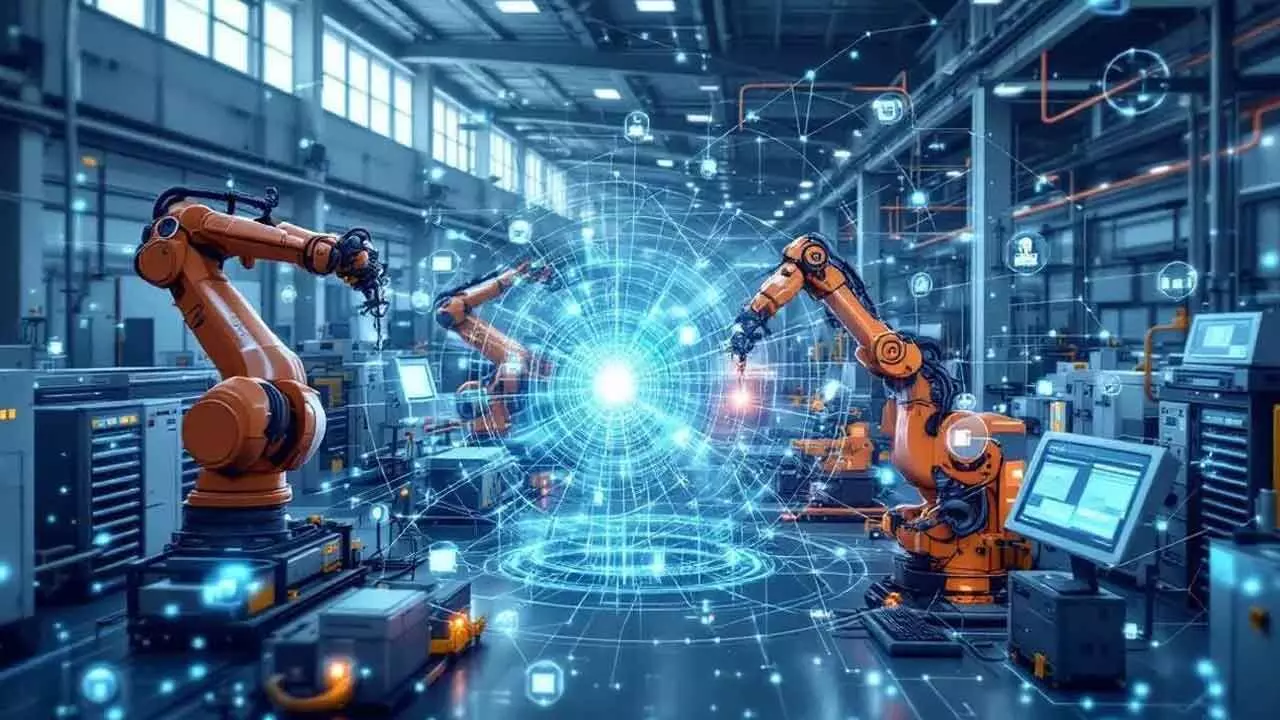
The future of manufacturing is being reshaped by rapid technological advances, sustainability efforts, and shifting consumer expectations. The result is a move toward more localized, automated, and intelligent production systems.
Manufacturing is undergoing a profound transformation as AI, automation, and climate pressure force operations to become faster, leaner, and smarter. Between 2026 and 2035, several key trends will define this shift.
Fully autonomous production sites are cutting energy use by up to 30% and reducing defects by as much as 99%. Companies such as Tesla and Siemens are scaling AI-powered “lights-out” facilities that operate continuously with minimal human intervention.
By 2026, 85% of manufacturers plan to regionalize production to avoid rising CBAM tariffs and reduce freight emissions. Apple, Zara, and Schneider Electric are already moving manufacturing closer to demand.
Labor shortages are accelerating automation. With 1.9 million US manufacturing jobs projected to go unfilled by 2030, companies like Hyundai and Sandvik are deploying exoskeletons, AI copilots, and AR/VR training to boost productivity and safety.
Predictive maintenance is reducing downtime by up to 50%. US manufacturers lead adoption, with platforms such as Factory AI using edge-powered analytics to lower data costs while maintaining uptime.
Digital twins are shortening planning cycles by around 30% and enabling real-time simulation. BMW and Renault leverage NVIDIA Omniverse to optimize factory layouts, energy consumption, and operations before physical deployment.
Robots are increasingly filling labor gaps, with global demand for humanoid units expected to exceed 1.1 million by 2035.
Additive manufacturing is on track to become a USD 90 billion market by 2032. Boeing, Adidas, and General Atomics now use multi-material printing and AI-based quality control for flight-grade components and high-performance footwear.
Urban factories are reducing lead times and eliminating freight emissions. Since shipping costs surged after 2020, brands such as Olympian Motors and Relocalize have shifted toward distributed, flexible production.
Modular and self-reconfigurable manufacturing cells can adapt in real time, reducing material waste by up to 90%. BMW and Volkswagen are piloting AI-driven modular systems to enable faster changeovers.
Servitization models such as Equipment-as-a-Service (EaaS) are expanding rapidly and are expected to reach USD 27.8 billion by 2030. Offerings like ABB’s robotics-as-a-service and Synctive’s pay-per-use billing are helping manufacturers generate recurring revenue and lower upfront costs.
Regulation is becoming a major catalyst. The EU will mandate product-level traceability by 2029, with Volvo, BMW, and Schneider Electric already deploying digital product passports to track emissions. New EU rules also require end-to-end risk mapping and emissions audits, affecting more than 6,000 companies by 2030.
Consumer behavior is reinforcing these shifts. About 74% of buyers are willing to pay more for sustainable goods, and companies such as Patagonia and Walmart show that locally produced products can command premiums while scaling efficiently and affordably.
Geopolitical tensions are delaying strategic development for 90% of manufacturers. This prompts a shift from low-cost hubs like China and Mexico to stable markets such as the UK and Japan.
Nearly 70% of CEOs expect negative impacts from changing trade policies, while 36% say finding the right talent is harder than in 2018, despite a larger overall workforce. If unaddressed, the US manufacturing sector could face a shortfall of 1.9 million workers by 2033, potentially costing the economy up to USD 1 trillion.
Already, 65% of manufacturers report skill shortages, and globally, 74% of employers are struggling to fill roles with skilled talent.
The US is 100% reliant on imports for 10 critical minerals and 50% to 95% dependent on 18 others. Many of which are dominated by China, which is home to 17 metallic elements that are critical components of the rare earth element supply.
Recent Chinese export controls have left US firms with just two to three months of buffer stock. Industry analysts warn that this supply risk could trigger a crisis comparable to “chip shortage on steroids” as these materials underpin technologies from electric vehicles to aerospace systems.
AI-native factories, also known as “lights-out manufacturing” plants, are self-optimizing and fully autonomous production ecosystems. They operate continuously in darkness and are run by AI, robotics, and connected systems.
AI-native factories are delivering 2x to 3x improvement in productivity, 50% improvement in service levels with 99% reduction in defects, and 30% decrease in energy consumption.
Philips, for example, operates a factory with 128 robots and just nine human quality inspectors to produce 20 million electric razor blades annually. Japan continues to scale FANUC’s long-standing automation model, while European manufacturers such as Siemens and Philips focus on ultra-high quality and advanced digital-twin capabilities.
These factories leverage real-time AI, computer vision, edge computing, and more to precisely optimize production cycles. From predictive maintenance and autonomous decision-making to energy usage, these factories contribute to 15 to 20% lower industrial energy consumption.
With thousands of emerging technologies and startups, navigating the right investment and partnership opportunities that bring returns quickly is challenging.





